
Designing Your Home Sanctuary: Crafting a Sacred Space for Daily Renewal
Updated: Aug 26

Let me paint you a picture.
It’s early.
The house is still quiet.
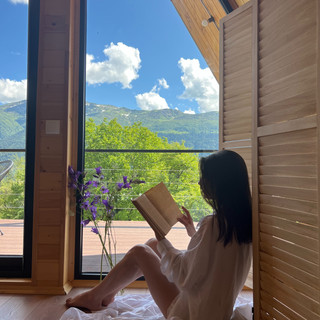
You make your way to the one corner of your home that just feels like yours - the chair by the window, the reading nook, the little spot on the floor with the good rug and the candle you light every single morning.
You sit down, take a breath, and something in your body actually unclenches.
That feeling? That’s what we’re building today.
I want to be upfront about something before we dive in: there is no rulebook here. No mood board you have to replicate, no Scandinavian aesthetic you need to adopt, no specific candle brand that will finally make your home feel sacred.
The idea of a sanctuary space is deeply, wonderfully personal - and the best version of yours is the one that makes you exhale, not the one that photographs well.
(Though those two things can absolutely overlap, and no judgment if they do.)
This is simply a collection of ideas, starting points, and gentle nudges.
Take what resonates. Leave what doesn’t.
Build something that is entirely, unapologetically yours.
First: It Doesn’t Have to Be a Whole Room
I think the word “sanctuary” can feel intimidating, like it requires a spare room, a substantial renovation budget, and probably a water feature.
It does not.
Some of the most intentional, peace-inducing spaces I’ve ever encountered have been a single chair in the corner of a bedroom, a cleared windowsill with a few plants, or a bathroom that smells like eucalyptus and has good lighting.
A sanctuary is less about square footage and more about intention. It’s the place - however small - where your nervous system gets the message that it can stand down for a little while.
So if you’re working with a studio apartment, a shared bedroom, or a house that is gloriously full of other people’s stuff and noise, that’s okay.
We’re looking for a pocket of peace, not a palace.
My own version of this is embarrassingly humble: a corner of my living room with an armchair I found secondhand, a lava lamp, a small stack of books, and a candle that smells like cedar and something vaguely mysterious.
It took about an afternoon to pull together and cost less than a nice dinner out. It is, without question, my favorite square footage in the house.
Start With the Feeling, Not the Furniture
Here’s a question worth sitting with before you buy a single thing or move a single piece of furniture: how do you want this space to feel?
Not look - feel.
Close your eyes and think about the most at-ease you’ve ever felt in a physical space.
Maybe it was a grandmother’s house that smelled like something baking. A hotel room that had the exact right weight of curtains. A friend’s apartment with plants everywhere and slightly mismatched furniture that somehow worked. A bench in a garden. A corner booth in a restaurant.
Identify that feeling first - calm, cozy, expansive, grounded, alive, hushed - and let it guide every decision after that.
When you start from the feeling rather than the aesthetic, you end up with a space that actually delivers on its promise instead of one that looks curated but leaves you cold.
A few words that might help you name it: soft, still, warm, light, natural, textured, minimal, layered, fragrant, quiet, alive.
There’s no wrong answer here. Just yours.
The Elements Worth Playing With
Once you know your feeling, here’s a loose toolkit of elements to play with. Mix and match freely.
Light with lots of intention around it.
Lighting is probably the single highest-impact, lowest-cost lever you can pull in any space. Swap a harsh overhead bulb for something warm-toned. Add a lamp at eye level rather than ceiling height. Try candles in the evening - not for the scent necessarily, but for the quality of light they cast.
There is something biologically soothing about candlelight; our brains recognize it as a signal to slow down. Use that.
Texture that invites touch.
A throw blanket you actually want to wrap yourself in. A rug that feels good underfoot. A pillow with a cover that doesn’t feel scratchy. These aren’t decorative details - they’re sensory cues that tell your body it’s safe to settle.
When you touch something soft and good, your nervous system notices. Give it things worth noticing.
Something alive.
A plant, a vase of whatever’s in season at the grocery store, a single branch from outside. There’s real research behind the idea that being around living things reduces stress and promotes a sense of calm - but honestly, you probably already knew that intuitively.
If you’ve historically killed every plant you’ve owned (same), start with a pothos or a snake plant. They are famously difficult to kill and I say that from personal experience.
Scent as a ritual anchor.
When you use the same scent consistently in your sanctuary space - the same candle, the same diffuser blend, the same incense - your brain starts to associate that smell with the feeling of the space.
Over time, lighting that candle or turning on that diffuser becomes a Pavlovian cue: time to exhale. It’s a small trick with a disproportionately large payoff.
A surface that stays clear.
Just one. A nightstand, a tray, a windowsill. One surface you commit to keeping uncluttered, where you put only things you love or that bring you peace. Visual rest is real - your eyes need somewhere to land that isn’t asking something of you.
One clear surface, consistently maintained, does more for the feeling of a space than almost anything else.
Objects with meaning over objects with price tags.
The most powerful thing in a sanctuary space is usually something that costs very little: the smooth stone you picked up on a walk. The framed photo from a day you want to remember. The mug that was your grandmother’s. The book that changed something in you.
Meaning is the ingredient that no design budget can substitute for - and you’ve already got it.
The Ritual Matters as Much as the Room
A beautiful space without a practice to anchor it is just decoration. And a simple practice without a dedicated space can feel hard to protect. The two work together - each one making the other more possible.
What’s the ritual you’re building the space around?
It doesn’t have to be elaborate. Morning journaling. Ten minutes of reading before bed. A cup of tea in the quiet before anyone else wakes up. An evening stretch with music you love.
Sitting down with a notebook. Sitting down with absolutely nothing and just being still for a few minutes.
When you pair a consistent ritual with a consistent space, something shifts. The space starts to do some of the work for you.
You walk in and your body already knows what comes next: slowness, presence, a moment that’s just yours.
That’s the whole goal, really. Not a perfect room. A reliable reset.
A Few Gentle Permission Slips Before You Go
Because sometimes we need someone to say these things out loud:
You don’t need to renovate. You need to notice.
Your sanctuary doesn’t need to look like anyone else’s.
You’re allowed to want a space that’s just yours, even if you share your home with people you love deeply.
Done and imperfect beats perfectly planned and never started, every single time.
It can change. It probably will. That’s part of it.
Start small. Start today. Start with whatever you already have. A blanket, a candle, a chair pulled slightly away from the wall to create the suggestion of a corner.
A cleared surface and a book you’ve been meaning to read. These things count.
They more than count.
Now Tell Me About Yours
I genuinely want to know what your version of this looks like - or what you’re dreaming it could look like.
Are you starting from scratch with a blank corner and a budget of approximately nothing?
Are you refining a space you’ve been tinkering with for a while?
Is there one element you’ve already nailed that you’re proud of (a great lamp, the perfect candle, a rug that changed your life)?
Drop it all in the comments. I love this conversation more than almost any other, because the answers are always so varied and so personal and so genuinely inspiring.
Your sanctuary might be exactly what someone else needed to picture before they could build their own.
And if you’re completely stuck and not sure where to start - tell me that too. Let’s figure it out together.


Comments