
Slow Living: How to Create White Space in Your Week
- Heather Drewett
- May 26
- 5 min read

A gentle walk through the analog rituals that give your days room to breathe - no productivity required.
There's a design principle I've always loved but only recently understood in my own life: white space.
In graphic design, white space isn't emptiness - it's intentional.
It's what makes the thing next to it legible.
Without it, everything collapses into noise.
You can have all the right elements and still end up with something unreadable, something that makes people's eyes slide right off the page.
I think about that a lot when I look at my weeks.
Last spring I was running a full schedule - not an unusual one by any normal standard, just the regular accumulation of a life with kids and work and a house that needs things from you constantly.
But I had this persistent feeling of being slightly underwater.
Not drowning, just...never quite surfacing.
I was technically resting in the evenings, but I was resting by handing my brain to my phone, which, it turns out, is not the same thing as actually resting at all.
What I was missing wasn't time. I had pockets of time.
What I was missing was white space - those unstructured, unoptimized little gaps where nothing is being consumed or produced.
Where your mind can just...wander.
Where you remember who you are when no one needs anything from you.
So I started, slowly and a little skeptically, replacing some of my scrolling windows with analog rituals.
Not all of them. Not dramatically.
Just ten minutes here, twenty minutes there, swapped out for something that asked nothing of me in return.
Here's what I found, and here's what I'd gently invite you to try.
· · ·
The Morning Tea Ritual (10 Minutes)
I know. I know. "Make your morning more mindful" is the most written sentence on the entire wellness internet, and I almost didn't include it for that reason.
But I'm including it anyway because it genuinely changed something for me, and I'd rather be honest than original.
The shift was small: I stopped making tea and immediately picking up my phone while it steeped.
Instead, I started just standing at the kitchen window and watching whatever was happening outside while I enjoyed my drink.
Birds. The neighbor's cat. The light doing its morning thing through the trees.
Absolutely nothing on quiet days.
I'd hold the mug with both hands - which sounds precious but is actually warm and nice - and I'd let my thoughts move around without directing them anywhere.
Ten minutes. That's all it ever was.
But I started noticing that I went into the rest of my morning slightly more like a person and slightly less like a machine that had just been switched on.
The day felt like it had an actual beginning, instead of just suddenly being underway.
If you want to try it: no phone until the mug is empty. That's the only rule.
Let the tea do its work and let yourself be slightly, temporarily, bored.
Boredom is where your brain goes to breathe.
The Ten-Minute Walk That Isn't for Exercise
I want to be specific about this because the distinction matters: this is not a workout walk.
This is not a 'get your steps in' walk. This is not a walk where you listen to a podcast or make a mental to-do list or plan dinner.
This is a walk where you go outside and look at things.
I started doing this after school pickup most days. We'd walk around the block - just one block, so slow it barely counts as movement - and I'd point things out to whoever was with me.
A good cloud. A garden coming back to life. The satisfying sound of gravel underfoot.
My kids think I'm slightly odd for it, which is fine.
What I've noticed is that they've started doing it too, quietly, without mentioning it.
The walk creates white space because it gives your senses something gentle and real to land on, which stops the mental scroll from happening automatically.
You can't ruminate as effectively when a robin is doing something interesting twelve feet away from you.
Nature is an interruption in the best possible sense.
Even ten minutes of this will recalibrate something. Start with one block. You don't have to earn it by going far.
Reading Something That Has Nothing to Do With Anything (20–30 Minutes)
Not self-improvement.
Not your industry.
Not something educational you've been meaning to get to.
A novel. A collection of essays someone you trust recommended.
Poetry, if that's your thing - and I'd gently suggest trying it even if you think it's not your thing, because the right poem at the right moment does something nothing else quite does.
I keep a book on the kitchen counter now, which sounds cluttered but is actually intentional.
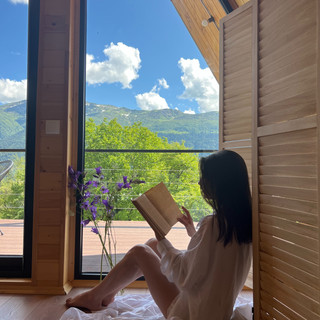
It means that when I'm waiting for water to boil or pasta to cook or the oven to preheat, I read two pages instead of checking my phone.
Two pages is nothing. Two pages, five times a day, is actually quite a lot of pages by the end of a week.
And unlike whatever I would have looked at on my phone, I remember them.
The specific magic of reading fiction, I think, is that it gives you a whole other nervous system to inhabit for a little while.
You get out of your own head by going fully into someone else's.
That's not escapism in the dismissive sense — it's one of the oldest forms of rest we have.
The Lost Art of Handwriting Something
Bear with me, because I know how this sounds.
I started keeping a small notebook on the coffee table last winter - not a journal, exactly, more of a catching-place.
I'd write down whatever was rolling around in my head: something I was grateful for, something that was annoying me, a description of what the evening light looked like, a line from whatever I'd been reading.
Three sentences, sometimes. Sometimes half a page.
No format, no goal, no one was ever going to read it.
What I didn't expect was how different it felt from typing.
Handwriting is slow, which is the whole point. It forces you to decide what's worth the effort of actually writing it down, which turns out to be its own kind of clarifying.
And there's something about the physical act - pen on paper, your own handwriting that's slightly messy and entirely yours - that feels anchored in a way that a screen never quite does.
You don't need a beautiful journal. You don't need a specific pen. A spiral notebook from the grocery store works perfectly.
Just write three sentences before you'd normally reach for your phone. That's the white space. Right there.
· · ·
Here's what I want you to hear, at the end of all this: you are not trying to become a more disciplined person.
You are not trying to optimize your leisure time.
You are just trying to remember what it feels like to be present in your own life for a few minutes a day.
White space isn't a luxury. It's what makes everything else legible.
Pick one of these. Just one. Give it a week and notice what happens in the quiet. I think you might be surprised by what shows up when you give it a little room.
And I'd really love to know - do you already have an analog ritual that anchors you? Or is there one here you're curious about?
Come tell me in the comments. I'll have my tea in hand.
Talk soon,
Heather


Comments