
Spring Self-Care for the Overstimulated Mind
- Heather Drewett
- May 27
- 5 min read

What rest actually looks like when you're tired in a way that sleep doesn't fix — and why your nervous system deserves a gentler spring than the internet is selling you.
Spring wellness content starts showing up in my feeds around mid-February, which I find quietly cruel.
It arrives before the crocuses do, before the light has even really shifted, while most of us are still in a deep long winter. And it is so relentlessly cheerful.
Green smoothies and cold plunges and 5am workout routines and glowing skin and the general implication that the correct response to a new season is to immediately optimize yourself for it.
I tried that version of spring self-care for years.
I would emerge from winter feeling wrung out and foggy, and I'd throw myself at a whole new set of demands dressed up in pastel packaging.
More movement. Better food. Earlier mornings. A skincare overhaul. A vision board.
I would do this for about eleven days, feel worse, and then feel additionally bad about feeling worse, because surely someone who was doing all the right things should feel better by now.
Here is what I eventually figured out, the hard way and then the slow way and then, finally, the easy way: what an overstimulated nervous system needs in spring is not more input.
It needs less.
It needs warmth and repetition and simple things. It needs evenings that end quietly.
It needs to be treated like something tender, because it is.
So this is not a glow-up guide.
This is a come-back-to-yourself guide.
There's a difference, and the difference matters.
· · ·
First: Understand What "Overstimulated" Actually Feels Like
Because I spent a long time not having a name for it, and naming it changed everything.
Overstimulation doesn't always look like frazzled and frantic.
Sometimes it looks like lying on the couch perfectly still and feeling vaguely unable to begin anything.
Sometimes it's the weird exhaustion that arrives after a day where nothing particularly hard happened.
Sometimes it's the irritability that flares up at small things - a loud noise, a question you've already answered, the specific chaos of everyone needing something from you at the same time - and leaves you feeling guilty and confused about your own reaction.
Your nervous system is the part of you that processes everything coming in: sound, light, social input, emotional demand, information, change.
When it's been running on high for too long - and most of us have been running on high for a very long time - it starts to misfire.
The volume on everything gets turned up. Rest doesn't land the way it should.
You feel both exhausted and unable to settle.
This is not a character flaw. This is a system in need of a slower, quieter kind of care. The kind we're going to talk about now.
Simple Meals as a Form of Mercy
When I am genuinely depleted, the last thing I need is to spend forty-five minutes executing a nourishing recipe I found on the internet, surrounded by eight different ingredients and a cutting board that needs washing afterwards.
What I need is a soft-boiled egg on rice. Soup from a pot I barely had to think about.
A bowl of whatever is simple and warm and doesn't require me to perform wellness at myself while I make it.
There is a version of self-care that has convinced us that eating well means eating elaborately, and I'd like to gently push back on that.
Soup that is mostly broth and a few vegetables you already had. Scrambled eggs with cheese and something green on the side. Pasta with olive oil and whatever herbs are lingering in the fridge.
These are not giving-up meals.
These are nervous-system meals - uncomplicated, warm, requiring almost nothing from you, giving back something steady and real.
When life is loud, let dinner be quiet. That is a complete sentence and a philosophy.
Rest That Actually Registers
For a long time I confused rest with inactivity.
I thought that lying on the couch scrolling was resting because my body wasn't moving.
It took me longer than I'd like to admit figuring out that my nervous system does not know the difference between watching a heated argument unfold on social media and being in the room where the argument is happening.
The activation is similar. The residue is the same.
Rest that actually works for an overstimulated nervous system tends to be slower, quieter, and more boring than we expect rest to be.
It looks like: sitting outside without your phone for fifteen minutes. A bath with the door closed and nothing playing.
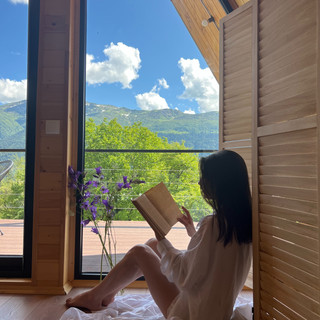
Reading something fiction and gentle — not thrilling, not devastating, just companionable.
Lying down in a quiet room and doing absolutely nothing, which is harder than it sounds and more restorative than almost anything else.
The goal isn't entertainment.
The goal is a nervous system that gets to stop scanning for the next thing.
That happens in quiet. It happens in stillness.
It happens in the low-stimulation spaces we increasingly have to fight to protect, and that are increasingly worth fighting for.
The Offline Evening (Or Even Just the Offline Hour)
I started doing this last autumn almost by accident - the kids were asleep, my husband was reading, and I'd misplaced my phone and couldn't quite be bothered to find it.
So I just sat there. In the quiet room, in the lamplight, with nothing in my hands.
It was genuinely uncomfortable for about four minutes. And then something released.
Now I try to do it on purpose, a few nights a week: phone in another room after eight o'clock, or after dinner, or after the witching hour of bedtime chaos has finally resolved itself.
What fills the space is always a little surprising.
Sometimes I read.
Sometimes I just sit and let my thoughts unspool without grabbing them.
Sometimes I find a coloring book and some markers.
Sometimes I practice my handwriting.
Sometimes my husband and I have a real conversation - the kind that doesn't happen when we're both half-present and half-somewhere-else on our phones.
You don't have to go offline all evening.
Start with one hour. Let that hour be genuinely, bravely boring.
See what surfaces when the noise stops.
I think you might find that what surfaces is you - a little quieter than usual, a little less jagged, more like yourself than you've felt in a while.
One Gentle Thing, Added Slowly
If you want to add something — a small routine, a new practice, something that feels like building toward something rather than just subtracting - let it be one thing and let it be gentle.
A short walk in the morning light, before you check your phone.
Five minutes of stretching on the floor while your coffee brews.
A few pages of something you actually want to read before the day fully begins.
One thing, small enough that it asks almost nothing of you, repeated often enough that it starts to feel like coming home.
This is how nervous systems heal, actually.
Not through dramatic intervention but through tiny, repeated signals of safety.
Here we are again.
Here is the same quiet thing.
You are okay. You can slow down.
It's alright to be here.
· · ·
Spring doesn't have to be an upgrade. It can just be a thaw.
It can be the slow return of light and the slow return of you to yourself - a little less defended, a little more rested, a little more willing to believe that you don't have to earn your own gentleness.
You're allowed to have a spring that looks like soup and early evenings and a good book and nothing more impressive than that.
That is enough.
You are enough. And your nervous system, bless it, has been waiting all winter for you to finally say so.
What does rest actually look like for you right now - in this season, in this particular stretch of life?
I'd love to hear it.
Tell me in the comments. I'll be here, offline and unbothered, probably eating something very simple for dinner.


Comments