
The Lost Art of Doing Nothing on Purpose
Updated: Aug 26
A gentle case for rest that doesn’t need to earn anything

I almost ruined a perfectly good Saturday a few weeks back, and I want to tell you how.
The day had opened up out of nowhere - plans fell through, my list was already done, I had hours with nothing attached to them.
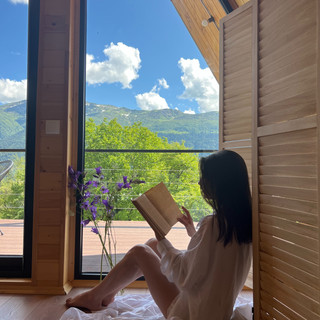
It was one of those early afternoons where the light comes in low and gold and makes everything look a little older than it is.
I made tea.
Sat down.
And within about four minutes I had my laptop open and was halfway through an email that could have very easily waited until Monday.
I caught myself. Closed the laptop. Sat back.
And immediately thought: I should reorganize the bookshelf.
Or go for a run.
Or read something with footnotes, at least, something I could point to later.
The idea of just sitting there - tea, light, doing absolutely nothing that anyone could measure - made me uncomfortable in a way I couldn't fully explain.
Like there was a low hum of wrongness under the stillness.
Like I was getting away with something I hadn't paid for.
You know that feeling. I know you do.
Somewhere along the way we decided rest has to be earned, and worse, that it has to justify itself once it arrives.
You worked hard, so now you get the weekend - as a reward, not a right.
And when the rest finally shows up, it comes with strings attached.
It should be "productive rest," the kind that recharges you so you can go back to being useful.
Or it should at least be active - a long walk, a project, something you can report back on later.
Rest that just happens, an afternoon that goes nowhere and means nothing, starts to feel suspiciously close to wasted.
I spent most of my twenties like this.
Every idle moment felt like an opportunity I was failing to seize.
Vacations made me a little anxious because I wasn't optimizing them properly.
Sundays were either frantic or guilty, no in-between.
Even my hobbies turned into projects, quietly, without my permission - things with goals now, progress to track, something to post.
It took a real, bone-deep burnout - the kind three good nights of sleep does absolutely nothing for - to make me sit with why stillness scared me so much.
What I thought would happen if I stopped.
What I was worried the quiet would show me.
The answer, when I actually found it, was simpler than I expected and a little sadder.
I was scared that if I stopped being useful, I'd stop being worth anything.
That unearned, unstructured rest would expose some smallness at the center of things that being busy had been quietly covering up.
It was never really about productivity.
It was about whether I thought I was allowed to just exist without a reason for it.
I don't think I'm the only one carrying that around, dressed up as a work ethic.
Before everything sped up, slow afternoons weren't a luxury.
They were just Tuesday.
Cultures all over the world built rest into the actual shape of the day - the siesta, the long Sunday, tea that nobody rushed.
Not laziness.
Just an understanding that people aren't machines, and that time without a task attached to it isn't time wasted.
I think about my grandmother, who could sit in her garden for an entire afternoon with tea beside her and a magazine she wasn't really reading, and seemed completely fine with that.
She wasn't recovering from anything.
Wasn't gearing up for anything either. She was just there.
I used to think that was a little odd, honestly.
Now I think it might be the most impressive thing about her.
What we lost isn't the hours - we've got the same twenty-four everyone's always had.
What we lost is permission to move through them slowly.
To let an afternoon just be an afternoon, long and aimless.
To watch the light cross a wall.
To read a page and then just sit there thinking about it instead of turning the next one.
To drink the tea while it's still hot, and not do anything else while you do it.
Simple to describe. Genuinely hard to pull off.
Here's what I actually believe now, after a lot of resistant, fidgety sitting-in-chairs: rest doesn't need a reason.
You don't have to be exhausted to deserve a break.
You don't have to have suffered or produced or been good enough first.
You're allowed to rest because you're a person, and people need rest.
That's the whole argument.
It doesn't need to be longer than that.
Knowing that in your head and actually feeling it in your body are two different projects, though.
The second one takes practice.
You have to sit down and do nothing, again and again, until your nervous system starts to believe nothing bad happens.
That the world keeps turning.
That no one's grading you.
That quiet isn't dangerous.
The first few times, it'll probably feel bad. You'll reach for your phone.
You'll think of six things you should be doing instead.
A low hum of guilt will show up that feels suspiciously like anxiety.
That's normal - it's just momentum from a life that's been moving fast for a while.
It doesn't switch off the second you sit down.
What's actually helped me is turning the nothing into a small something - not a productive something, just a felt one.
Tea you actually taste instead of just holding.
A window you actually look out of.
Music you let happen to you instead of putting on in the background while you do six other things.
The nothing turns into an experience instead of just an absence, which makes it a lot easier to stay inside.
Naming it helps too. Saying, even just in your own head: I'm resting on purpose right now. This is the thing I'm doing. I'm not behind. This is enough.
The first time I actually managed a whole slow afternoon - genuinely slow, phone in another room, nothing quietly waiting in the back of my mind - I felt something close to relief, except sadder than that word usually implies.
Like something in me had been holding its breath for a long time and finally let it go.
I hadn't realized how much I needed it until I actually had it.
There's a phrase in Japanese aesthetics, mono no aware - the bittersweet awareness that things don't last.
Cherry blossoms are the classic image: beautiful specifically because they're already leaving.
I think about how much of ordinary life we skip past because we haven't learned to look at it that way.
The sunlight. Rain on the roof. Coffee before anyone else is up.
The way a good book actually feels in your hands once you're still enough to be inside it instead of just holding it while you think about something else.
These aren't rewards waiting for us once we've earned enough.
They're happening right now, underneath everything we're busy doing, and they keep happening and passing whether we notice or not.
People sometimes say "finding beauty in ordinary moments" with a slight eye-roll, like it's a consolation prize for people who can't access anything more impressive.
I want to push back on that.
Hard, actually.
Noticing the unremarkable is not a lesser skill.
If anything it's a harder one - it's what most of the art we actually remember has been trying to teach us the whole time.
When I finally stopped fighting that afternoon and just sat in it - tea, light, some faint noise outside - time did that thing it only does when you stop rushing it.
It wasn't a dramatic kind of beautiful.
It didn't photograph well.
It's not a story I'd tell at a dinner party.
But it settled into me and stayed there, like warmth does.
That's what I'm actually after, when I go looking for slowness.
Not an escape from my life.
Just my life, felt all the way through, without the static.
A few things that have actually helped, if you want to try this - not a system, just what's worked for me or people I love.
Start smaller than feels necessary.
Five minutes with your tea before you touch your phone in the morning.
Ten minutes in the afternoon where you're just in the room.
Build from there.
Your nervous system does better with a slow on-ramp than a hard stop.
Give the rest a container.
This is where a little ambience genuinely helps - music, rain sounds, whatever signals to your body that this particular stretch of time is different.
Not work time.
Just soft time.
Take the exits away.
Phone in another room, face-down, silenced - whatever it takes.
If there's an easy way out of stillness, you'll take it, every single time, until you've built the muscle not to need one.
Make the stillness the easiest option available, even just for a little while.
And let the small stuff be small.
The tea doesn't need to become a ritual with a name.
The light doesn't need a caption.
Let it just be a Wednesday afternoon that happens to feel, if you're paying attention, like something worth having.
I went back to that afternoon, in a way - not literally, it was gone - but I started building versions of it on purpose.
Slow Saturdays.
Quiet Sunday mornings.
Afternoons with nothing on them and a low tolerance for my own attempts to fill them anyway.
It hasn't fixed everything.
Burnout doesn't have a finish line you cross and then you're done.
It's more like relearning a pace your body can actually sustain, over and over, probably for a while.
And part of that has been letting an afternoon go nowhere without deciding it was wasted.
Not an absence.
Just a different, quieter kind of presence.
I think most of us are running on a background exhaustion we've all just agreed to normalize, mostly because everyone around us seems to be doing it too.
And I don't think the fix is a vacation or a new routine or a better-optimized schedule.
I've tried those.
They just become one more thing to manage.
I think the fix, if there is one, is permission.
Quiet, self-issued permission to sit in the light with your tea and let time pass without asking it to mean anything, except that you're here, and for this one hour, you're not chasing anything at all.
When did you last do nothing on purpose?
Not sleep, not scroll, not half-watch something while you fold laundry.
Actually nothing.
Sat in a room and let the time go slow.
If it's been a while, I'd be curious what gets in the way.
Guilt?
A mind that's been moving too fast for too long to just stop?
The sense that the pause needs to be earned before you're allowed to take it?
I ask because I suspect we've all got more in common here than we let on, and there's something to be said for admitting it out loud.
Tell me in the comments, here or on the channel - I read all of it, usually slowly, usually with my own cup of tea going cold beside me.
And if you've come over from YouTube, you already know what the videos are trying to do: build a little room for exactly this kind of pause.
Something to sit inside while the afternoon does its thing.
Haven't found the channel yet?
Nothing's on the agenda over there either.
-Heather


Comments