
The Noise Is Loud Right Now. You Don't Have to Match It.
Updated: Aug 26
On finding your way back to yourself when the world keeps asking for more than you have.

There's a particular kind of tired that doesn't show up on any checklist.
It's not the tired from a hard week or a bad night's sleep.
It's the tired that lives underneath those things.
The kind where you've been giving and absorbing and producing and responding for so long that something inside you has quietly gone offline, and you're running on a kind of automated politeness that you call "fine" and mostly get away with.
You probably know exactly what I mean.
We talk a lot about burnout now, which is good - it has a name, which is more than we had before.
But I think there's something that happens before burnout that we haven't quite named yet.
A long middle stretch where you're not falling apart, exactly, but you're also not okay.
Where you keep going because stopping feels harder than continuing, and because the world doesn't slow down to wait for you, and because - if you're honest - you're not sure what stopping would even look like.
This is for that stretch.
For the middle.
For the people who are functioning fine and struggling quietly and have forgotten what it feels like to not be braced for the next thing.
Why Doing More Doesn't Fix the Feeling of Having Nothing Left
When we feel depleted, the instinct is often to try harder.
To fix ourselves with effort.
To find the right routine, the right habit, the right amount of kale or cold water or structured journaling that will make us feel like ourselves again.
I've done this.
I have optimized myself directly into the ground and then wondered why I felt worse.
Here's what I've come to understand: an overstimulated, overwhelmed nervous system does not heal through addition.
It heals through subtraction.
Through less noise, less demand, less incoming information.
Through being asked to do fewer things for a little while.
Through rest that is actually restful, which is a different thing entirely from rest that is just inactivity between obligations.
The problem isn't that you need more.
The problem, almost always, is that you've been running too hot for too long and your system needs a chance to regulate.
That doesn't happen through a new wellness protocol.
It happens through quiet, and repetition, and very small acts of care that ask almost nothing of you.
On "Productive Rest" and Why It's Still a Trap
Someone once recommended I try "productive rest" - activities that restore you while also generating something useful.
I considered this for about thirty seconds before realizing it was just work with better lighting.
Actual rest - nervous-system rest, the kind that makes a difference - has no output.
That's the whole point.
It is a bath.
It is a slow walk without a podcast.
It is sitting with a cup of something warm and not also checking your email.
It is reading a novel that is gentle and companionable rather than urgent or improving.
It is doing nothing, which sounds simple, which is actually radical, which most of us are genuinely bad at.
Your nervous system cannot tell the difference between consuming upsetting content online and being in an upsetting situation in person.
The activation reads the same.
The residue it leaves is the same.
What looks like rest from the outside - lying on the couch, puttering around the house - can actually be its own form of stimulation if you're half-present and half-somewhere-else on a screen.
Real rest is low-stimulus.
It is slightly boring.
It feels almost uncomfortably slow at first, and then something shifts, and you realize you've been clenching something for a very long time.
The Case for Simple Dinners and Quiet Evenings
I want to make a case for the humble, uncomplicated thing.
A dinner that requires ten minutes and one pot. An evening that ends early, or at least without screens. A weekend that has nothing scheduled in it beyond whatever you feel like doing when you get there.
These are not signs of a life un-lived.
They are not laziness dressed up as self-care.
They are, when you actually need them, a form of repair.
When everything around you is asking for a response - the notifications, the news, the needs of people you love, the ambient sense that you should be doing more and better - choosing a quiet evening is a small act of resistance.
It is saying: I don't have to match the noise. I am allowed to let things be slow tonight.
There's something that happens in the slow evenings that doesn't happen in the busy ones.
Your thoughts get to unspool on their own, without being grabbed.
You notice what you actually feel like, instead of what the day has been telling you to feel.
You come back to yourself a little - not dramatically, not in a way you could point to and explain, just incrementally, quietly, the way ground thaws.
One Small Thing, Repeated
If you're looking for something to add - one small practice, one gentle anchor - I'd offer this: let it be one thing, and let it be easy.
Not a whole new morning routine.
Not a transformation.
One thing, small enough that you can do it even when you're tired, consistent enough that it starts to feel like something reliable.
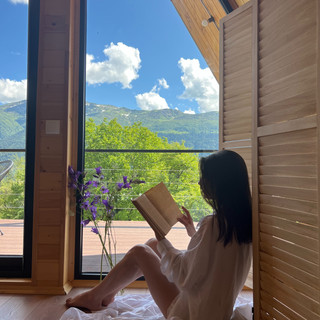
A few pages of a book you're actually enjoying, before the day takes you.
Five minutes outside with your hands around a warm drink and your phone in your pocket.
Writing three sentences in a notebook before you go to sleep - not a journal, not a gratitude practice, just three sentences about whatever happened today.
Something that marks the day as yours.
This is not a small thing dressed up to seem like enough.
This is genuinely how change happens - not through intensity, but through repetition.
Not through the grand gesture, but through the small one, made again and again, until it becomes the shape of a different life.
You are allowed to move through the world more gently than the world seems to expect.
You are allowed to log off.
To rest without earning it.
To have a quiet evening that produces nothing.
To eat something simple and go to bed early and let that be the whole story of a Tuesday.
The noise will be there tomorrow.
It will be there next week.
It has always been there, and it will not stop being there because you spend one evening ignoring it.
But you - the version of you underneath all the adapting and responding and keeping up - that version deserves a little quiet.
A little warmth.
A little space to come back into focus.
That is not a luxury. That is maintenance. And you are worth the maintenance.
What does a genuinely restful day or evening look like for you, right now?
Not the ideal version - the real version, the one that's actually available to you this week.
I'd love to know. Leave it in the comments.



Comments